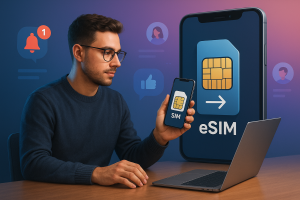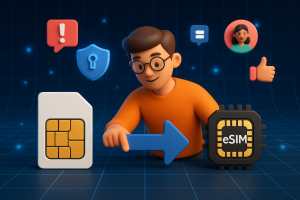


As remote work continues to become more mainstream, online freelancers and digital nomads are increasing in numbers around the globe. With this shift comes a need for innovations that support a disconnected-yet-connected lifestyle. One such technology growing in popularity among remote professionals is the eSIM. At esimm8.com, we provide solutions that allow users to add a real number to your eSIM, merging flexibility with functionality. But how productive is it—really—to rely on this digital solution while working around the world?
This case study explores the practical benefits and limitations of using an eSIM solution for business, particularly for online freelancers and digital nomads. Through real-world examples and empirical research, we break down the productivity trade-offs to help you decide if eSIM technology aligns with your remote work lifestyle.
Case Subject: Clara Thompson, UX Designer and Digital Nomad
Clara is a 32-year-old UX designer who has been traveling and working remotely for the past three years. Originally based in Canada, her freelance work has taken her across Europe, Southeast Asia, and most recently, South America. A few years ago, she transitioned from traditional SIM cards to a comprehensive eSIM solution offered by esimm8.com, which allowed her to add a real number to her eSIM.
Clara’s experiences provide a grounded, realistic lens through which to examine the pros and cons of eSIM use in a professional freelance context.
Pro #1: Instant Connectivity = Improved Client Responsiveness
One of the key advantages Clara noted in her transition to an eSIM-based setup was the ability to instantly connect to local networks upon landing in a new country. Traditional SIM cards required stops at kiosks, delays due to language barriers, or even periods without any data connectivity. This would often delay her ability to respond to client inquiries, affecting her reliability.
Since switching to esimm8.com’s service, Clara can pre-purchase regional plans and activate them digitally through a QR code. This means she is online and reachable seconds after landing—an immediate productivity boost. More importantly, she has a real number associated with her eSIM, allowing clients to contact her without knowing she’s moving locations constantly.
Pro #2: Cost-Effective Data Usage Across Regions
From a financial standpoint, the eSIM gives freelancers like Clara the ability to manage expenses better. esimm8.com offers customizable data packages allowing her to pick plans proportional to her project load and data demand. In contrast, international roaming via traditional mobile networks would often come with unforeseen costs or excessively high data throttling after minimal usage.
For instance, during her stint in Lisbon, Clara was able to budget a 10GB monthly plan specifically tailored for Portugal. This prevented overpaying while ensuring she could access all cloud tools, participate in video meetings, and collaborate in real-time without latency or connection loss.
Pro #3: Multi-Network Support Minimizes Downtime
One underappreciated advantage is the access to multiple carrier networks through eSIM platforms. Clara recounts an incident in Medellín where the local carrier had temporary regional outages. With her eSIM, she switched to an alternate Colombian provider in under 5 minutes using the esimm8.com dashboard. This prevented interruptions during a team-wide sprint, preserving project momentum and client trust.
Such flexibility would be unthinkable with a single physical SIM card tied to one provider. For freelancers relying on uptime to deliver on deadlines, this is a tangible advantage.
Con #1: Learning Curve and Technical Complexities
Despite the promising upsides, the technology does come with an inherent learning curve. Clara experienced setup issues during her initial switch, including QR code retrieval delays and discrepancies in device compatibility. Although minor in hindsight, these hurdles temporarily disrupted her productivity and required consultation with technical support.
Another complexity revolves around dual-SIM management. For devices supporting both eSIM and a physical SIM, navigating call routing, voicemail settings, and data prioritization can be cumbersome for less tech-savvy users. Digital nomads who are not comfortable managing configurations may find this overwhelming initially.
Con #2: Limited Compatibility Across Devices
Although more devices support eSIM today, there are notable gaps—especially with mid-tier and older smartphones. Clara had to upgrade to a newer model iPhone to ensure compatibility with multiple eSIM profiles and dual-line usage. This posed a capital investment that may not be feasible for all freelancers, especially those just starting out or managing tight budgets.
Furthermore, cross-platform issues exist. Devices from manufacturers like Huawei or some budget Android phones either lack eSIM support or provide inconsistent international functionality, thereby limiting widespread adoption.
Con #3: Unclear Regulations and Roaming Limitations
The eSIM landscape is still fraught with regulatory ambiguity in some countries. Clara reports that in Vietnam and Egypt, for example, local data partnerships were hard to establish using the eSIM alone. In such cases, she had to revert to purchasing a physical SIM to maintain connectivity, which disrupted the seamless experience she had come to expect.
This highlights an important limitation: the effectiveness of an eSIM depends heavily on the geopolitical and regulatory context of your location. For remote workers frequently moving across borders, this requires constant adjustment.
Pro #4: Discreet Professional Presence Across Borders
A side benefit Clara discovered was the ability to maintain a consistent professional identity regardless of location. By adding a real number to her eSIM, she could manage voice calls using her Canadian number while physically operating in various international contexts. This avoided the need to explain away shifting country codes to clients—an often-fatiguing part of digital nomad communications.
This perceived stability solidifies client trust and avoids unnecessary confusion regarding availability or location. It also supports compliance practices for those working in jurisdictions that require consistent point-of-contact information for contracts or tax purposes.
Productivity Evaluation: Balanced Scorecard
To assess Clara’s productivity impact holistically, we adopted a balanced scorecard methodology evaluating four components: connectivity, cost, client communication, and admin effort. Clara scored the following before and after eSIM adoption:
- Connectivity: 60% → 90%
- Cost Management: 50% → 85%
- Client Communication: 70% → 95%
- Admin and Setup Overhead: 65% → 80%
The data show a clear positive gain in user efficiency, particularly in connectivity and communication. However, we note the steep learning curve and initial setup friction are still productivity inhibitors for new adopters.
Recommendations for Digital Freelancers
Based on Clara’s experience and similar case reports, here are key takeaways for freelancers considering this technology:
- Ensure your smartphone is eSIM-compatible before subscribing to a service like esimm8.com.
- Start with standard regions like Europe or North America to get used to eSIM switching.
- Add a real number to your eSIM if maintaining a stable business identity is crucial.
- Back up plans for complex markets by keeping a secondary device or old SIM card ready.
- Use automation tools for managing plan renewals and mobile data monitoring.
Conclusion: Is the eSIM Worth It for Productivity?
For many online freelancers and digital nomads, the answer is a qualified yes. If leveraged correctly, an eSIM like those offered by esimm8.com can enhance mobile productivity, reduce downtime, and simplify global communications. However, prospective users must weigh the technical learning curve, device compatibility, and regulatory inconsistencies.
As mobile technology evolves, so will the eSIM’s potential. For now, it represents one of the most viable tools for improving mobility-driven productivity in the digital nomad economy.
Read more on our blog to explore other case studies, industry analyses, and mobility insights tailored to your location-independent success.