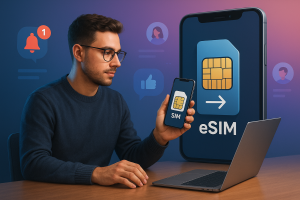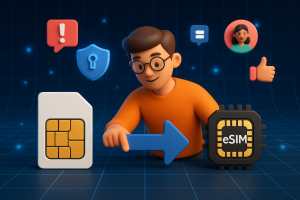


In the rapidly evolving digital landscape, the emergence of eSIM technology has stirred excitement as well as confusion. While it promises a more convenient and flexible approach to mobile connectivity, several myths continue to cloud users’ understanding. At esimm8.com, we believe knowledge is power. In this guide, we confront the most persistent misconceptions about eSIMs through a challenge-based lens—equipping tech enthusiasts with a clearer perspective on what eSIMs can truly offer, particularly when it comes to esim voice and messaging features that rival traditional SIMs.
Challenge 1: “eSIMs Only Work in the Latest Smartphones”
One of the most pervasive myths is that eSIM technology is exclusive to premium, cutting-edge phones. While it is true that earlier devices lacked built-in eSIM support, today’s reality is quite different. A growing number of mid-range smartphones, tablets, and even laptops now come eSIM-ready. Moreover, many digital devices—including wearables and IoT instruments—support eSIM integration.
Academic insight: Technology adoption curves have historically shown that after the early adopter phase, mid- and lower-tier hardware begins to embrace originally “premium” features. The eSIM trend mirrors this pattern. Open-source firmware and broader carrier partnerships have accelerated the democratization of eSIM accessibility across device classes.
Challenge 2: “eSIMs Can’t Handle Voice and Messaging Properly”
A common stumbling block for potential adopters is the belief that eSIMs are primarily data-only and cannot support traditional phone-level services. In fact, modern eSIM deployments fully support esim voice and messaging features, including VoLTE (Voice over LTE), SMS, MMS, and integrated messaging apps.
What many overlook is that the technical backend of eSIMs is identical to physical SIMs. Once a profile is installed and activated, the network treats it no differently than a traditional SIM. Regulatory and carrier support also ensure lawful interception, emergency calling, and number portability.
Challenge 3: “Switching Devices With an eSIM Is Complicated”
Contrary to the assumption that eSIMs “lock you in,” one of their greatest benefits is their remote provisioning capability. Rather than physically moving a tiny chip between devices, eSIM users can activate new profiles instantly via QR code, app-based management, or automatic carrier provisioning. This transitions the user from analogue logistics to digital fluidity.
Take, for example, global travelers. With eSIMs, switching between carriers or profiles based on location or pricing takes mere minutes—all without fumbling with SIM trays or adapters.
Challenge 4: “eSIMs Rely Too Much on Internet Connectivity”
While internet access is required initially to download an eSIM profile, once installed, that profile functions independently—just like a physical SIM. Your voice and messaging services do not require constant access to Wi-Fi or data to operate post-activation.
Clarification: There is a distinction between installing an eSIM (which is a one-time digital handshake requiring internet) versus daily usage (which leverages normal mobile networks). Modern LTE/5G rollout has only enhanced the reliability of eSIM-based connections.
Challenge 5: “eSIMs Are Less Secure Than Physical SIMs”
Security is perhaps the most critical—and misunderstood—aspect. Critics often argue that the digital nature of eSIMs makes them more hackable. However, the reverse is true. Remote SIM provisioning (RSP)—defined by GSMA standards—uses end-to-end encryption and strong authentication protocols.
Physical SIMs can be cloned or stolen. eSIMs, in contrast, are embedded into the device’s hardware and managed through cryptographic profiles. In the event of device loss, carriers can revoke access to the profile almost instantly, enhancing digital asset safety.
How to Harness the True Power of eSIMs
Understanding these challenges and myths is only the first step. To truly leverage eSIM capability, explore services like esim voice and messaging features offered through platforms like esimm8.com. Our infrastructure supports easy activation, seamless switching, and full-service connectivity across global networks.
For tech enthusiasts who demand speed, flexibility, and security from their digital tools, eSIMs offer a future-proof solution inherently better suited to today’s interconnected world.
Conclusion: The technological shift to eSIMs is not without its misunderstandings—but these stem from outdated paradigms. By challenging these misconceptions, we empower users to embrace a more agile and secure form of mobile connectivity. With full support for call and text functionality, extensive compatibility across devices, and greater control over account management, eSIMs represent the next intelligent step for any connected lifestyle.
Ready to unlock the full potential of eSIM voice and messaging features?
Get started today with esimm8.com and embrace the future of mobile connectivity with confidence.