

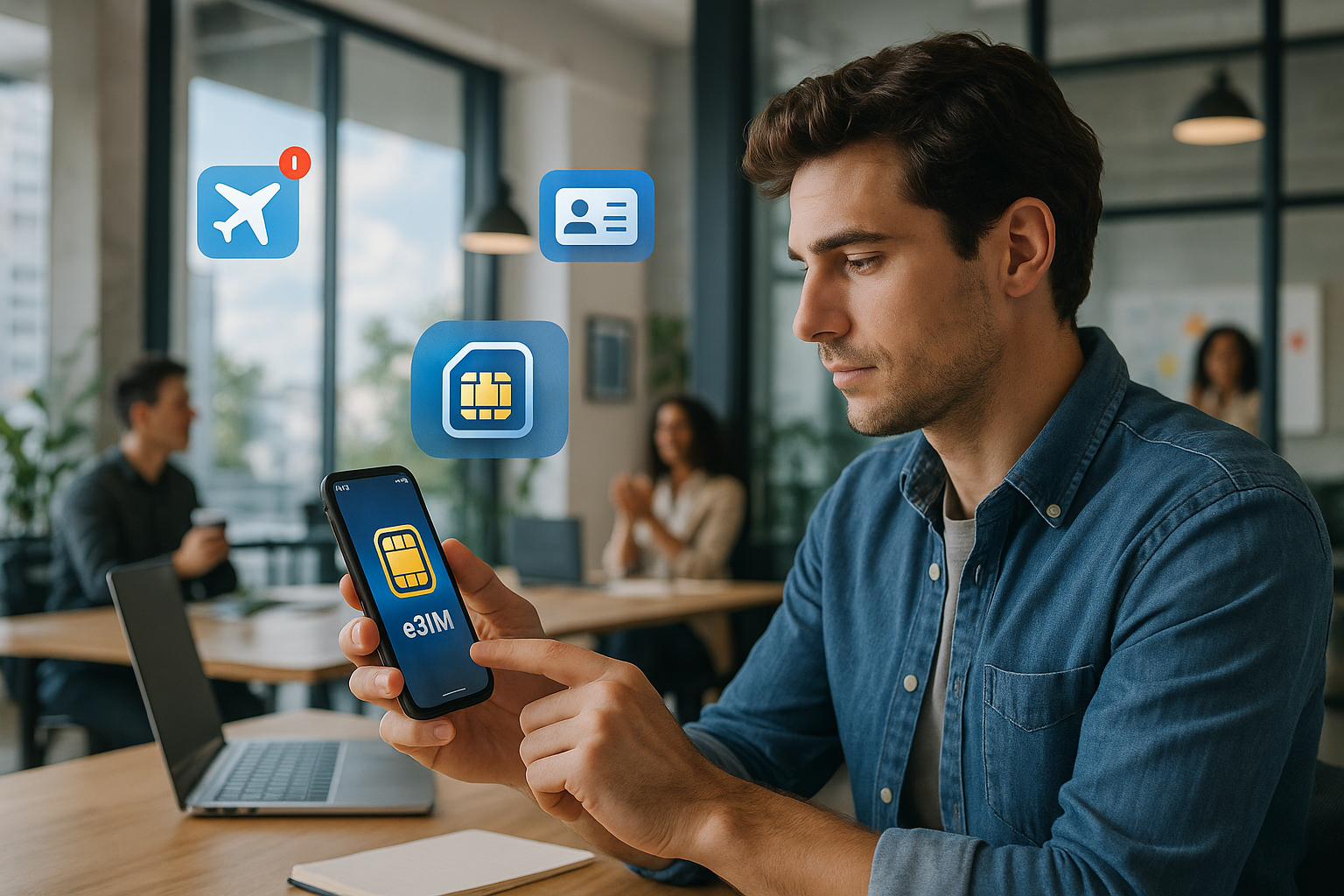
In a world defined by digital transformation, travelers are finding themselves at a crossroads between convenience and connection.
The emergence of eSIM technology promises seamless travel experiences—instant connectivity, simplified device management,
and a unified global identity. Yet, many frequent travelers still harbor misconceptions about what eSIMs can and cannot do.
At esimm8.com, we understand that embracing innovation requires clarity.
As your empathetic coach in the digital arena, this article explores how an eSIM with identity and communication tools
can transform not just your travel experiences but your digital lifestyle.
Through an academic lens and a real-life case study, we will dissect assumptions and illuminate truths about the evolving world of mobile connectivity.
Understanding the Core of eSIM Technology
The embedded SIM, commonly known as eSIM, represents a paradigm shift in digital communication infrastructure.
Unlike traditional SIM cards—small, physical chips requiring manual installation—an eSIM is built directly into your device.
This gives travelers the ability to switch networks digitally, without purchasing or inserting new hardware.
The underlying principle is rooted in the concept of network virtualization, enabling users to store multiple digital profiles
and activate them with a few taps. In the context of global mobility, eSIM technology provides a foundation for
permanent global identity—a secure and verifiable digital presence that transcends borders.
The technical framework supporting eSIMs follows rigorous global standards defined by GSMA, ensuring interoperability and
compatibility with multiple carriers worldwide. This universal protocol means that an eSIM with identity and communication tools
can operate across regions, maintaining a consistent connection even when traditional roaming would be prohibitively expensive or unreliable.
Common Misconceptions About eSIMs
Despite widespread adoption, misconceptions continue to circulate—particularly among frequent travelers accustomed to
physical SIM management. One of the most prevalent myths is that eSIMs are constrained to specific countries or tied to
particular devices. In reality, modern eSIMs are designed for interoperability across numerous mobile ecosystems.
Another myth suggests that using an eSIM compromises security. On the contrary, because eSIMs use encrypted provisioning
and remote management, security is often significantly enhanced compared to traditional cards.
There is also the notion that activating an eSIM requires complex technical knowledge. However, contemporary eSIM
platforms such as esimm8.com have simplified the process through user-friendly
interfaces, QR code-based activation, and automated network configuration tools. This accessibility
empowers even non-technical travelers to establish a secure global connection within minutes.
Real-Life Case Study: A Business Traveler’s Experience
Consider the case of Elena, a senior business consultant who travels between London, Singapore, and New York
on a bi-monthly basis. For years, she relied on multiple physical SIM cards to manage her connectivity—a system that
often led to confusion, high costs, and inconsistent communication. During one trip, a misplaced SIM card caused her
to lose two-factor authentication access for several accounts, disrupting critical work communications.
Seeking a permanent solution, Elena adopted an eSIM with identity and communication tools from esimm8.com.
This digitized her mobile identity and integrated her authentication methods directly within her eSIM profile.
The seamless transition between countries eliminated roaming charges and simplified her digital footprint.
Moreover, the eSIM’s multi-carrier compatibility meant she was always on the most efficient local network, optimizing both
performance and cost management.
The outcomes were transformative. Elena reported saving over 60% on connectivity costs annually while experiencing
a 40% improvement in call and data reliability during her travels. The integration of secure identity layers also
reduced the risk of compromised access, granting her peace of mind.
The Role of Digital Identity in Modern Travel
The conversation about eSIM technology extends beyond connectivity—it encompasses the broader domain of digital identity.
In today’s interconnected environment, identity verification underpins all forms of digital interaction, from accessing cloud systems
to authorizing online payments. An eSIM equipped with advanced identity and communication tools acts as a unified credential,
connecting your professional and personal digital worlds securely.
As travel becomes increasingly digitized, identity portability is key.
Travelers need seamless, continuous recognition across borders, without the administrative burden of repeated verification.
The integration of identity tools within eSIM architecture achieves this by binding verified credentials directly to your mobile device
in an encrypted environment. Essentially, the eSIM becomes your digital passport—verifiable, agile, and globally accepted.
Debunking the Data Privacy Concerns
Some skeptics raise valid concerns about data privacy. How secure is a digital identity stored on a device’s eSIM module?
Academic studies and cybersecurity audits have demonstrated that eSIMs implement advanced security measures, including
PKI (Public Key Infrastructure), remote provisioning, and decentralized credential verification.
These mechanisms drastically reduce vulnerability compared to traditional plastic SIMs, which can be easily lost or cloned.
At the institutional level, platforms like esimm8.com invest heavily in compliance with international data protection frameworks
such as GDPR and ISO/IEC 27001. In practical terms, this means that users retain full control over when and how their identity data is shared.
Rather than being an invasive tool, the eSIM serves as a privacy-preserving interface that empowers users to maintain their autonomy online.
Academic Insights: The eSIM as a Catalyst for Digital Evolution
From an academic standpoint, eSIM technology is not just a technical innovation—it is a sociotechnical evolution.
It signifies the movement toward decentralized identity management, global authentication protocols,
and a more human-centered interpretation of digital mobility. The evolution of the eSIM parallels the history of the Internet
in its democratizing effect: what once required dedicated infrastructure now fits into the palm of your hand.
Research publications highlight that by 2030, over 6 billion active eSIM-enabled devices will exist globally.
This figure is more than a projection; it is a signal of a larger cultural shift toward borderless communication ecosystems.
For frequent travelers, the benefit lies not only in convenience but also in alignment with a digital future that values identity integrity,
user autonomy, and sustainable connectivity models.
Why the Shift to eSIMs Is Inevitable
As mobility becomes more digitized, maintaining separate SIM cards for each region will soon be obsolete.
eSIM adoption is accelerating because it aligns with the principles of modern digital ecosystems:
interoperability, sustainability, and scalability. Carriers benefit from reduced physical supply chains,
and users benefit from flexibility and speed. Furthermore, the environmental implications are noteworthy—by removing
the need for plastic SIM production, eSIMs contribute to a reduction in electronic waste and resource usage.
Ultimately, the eSIM is not merely a technical advancement; it is a vehicle for redefining human interaction in a connected society.
Traveling with an eSIM with identity and communication tools means traveling with the confidence that your
digital presence remains intact, secure, and functional, no matter where you are in the world.
Empowering the Next Generation of Travelers
For today’s global citizens, the line between personal and professional connectivity is increasingly blurred.
Remote work, digital nomadism, and global collaboration models demand
a reliable communication framework that supports dynamic lifestyles.
With eSIMs, travelers gain autonomy—not only over their devices but over their digital identity as well.
This empowerment is central to esimm8.com’s mission: to provide intelligent,
identity-driven connectivity solutions that merge security with freedom.
The empathetic approach to technology adoption means understanding the user’s anxiety about change.
Transitioning from physical to digital systems can be daunting. That’s why platforms like esimm8.com emphasize
guided onboarding and education, helping travelers transform uncertainty into confidence.
Conclusion: Redefining the Digital Journey
The digital travel ecosystem is undergoing an unprecedented transformation.
Misconceptions about eSIM technology often stem from outdated models of connectivity.
As our real-life case study demonstrated, the power of adopting an eSIM with identity and communication tools
lies in its ability to unify, protect, and liberate the traveler’s digital presence.
By removing physical constraints, we make room for a more human-centered connection model that honors both technological progress
and personal empowerment.
For frequent travelers ready to embrace the next phase of global connectivity, the eSIM is not just an option—it’s a necessity.
Explore the full potential of intelligent connectivity and learn more insights on how to navigate the digital travel landscape at
esimm8.com.
Read more on our blog to continue your journey toward smarter, more seamless, and secure travel experiences.


