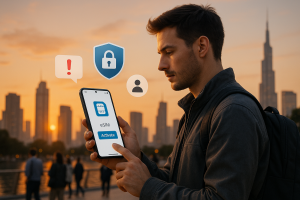


There you are—perched in your favorite café in Lisbon, sipping an oat milk latte, Zoom screen-sharing with your California-based client while uploading the latest design mockup to a Singaporean cloud server. You’re a modern freelancer, a digital nomad, a passport-stamped powerhouse. But while you’re busy freelancing your way around the globe, have you ever stopped mid-latte-sip and muttered, “Wait… how secure is all of this?”
That’s where we step in. At esimm8.com, we’ve made it our mission to keep your digital journey smooth, safe, and secretly awesome. In this listicle-laced FAQ, we’re diving into the meaty mysteries of mobile tech privacy and giving you all the witty wisdom you’ll need to keep your virtual ducks in a row. Ready to become that freelancer who turns heads not just with work ethic but with cyber-savvy? Let’s go.
1. What exactly is an eSIM, and why should I care?
eSIM is short for embedded SIM—it’s a digital SIM card built into your device, which means no more fiddly plastic or losing that paperclip-shaped SIM tool mid-flight. For freelancers jetting from one timezone to the next, this means instant access to local data, easier number switching, and extra room in your pocket (or soul).
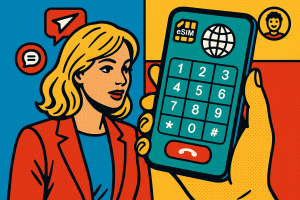
Oh, and here’s the kicker—when you add a real number to your eSIM, you move up several chess moves on the privacy and professionalism boards. That way, you can book client calls without giving away your solo number or navigating dual-SIM madness.
2. Is an eSIM more secure than a traditional SIM?
In short? Yes—like triple-chocolate-cake better. Traditional SIM cards can be physically stolen, cloned, or swapped (hi, SIM swap scams), but an eSIM is embedded in your phone’s hardware and protected by modern encryption and device-level authentication.
Imagine James Bond swapped his Aston Martin for a digital startup. That’s you—with your espionage-grade mobile firewall.
3. Can someone still intercept my calls or messages on an eSIM?
If someone’s trying to intercept your data as a freelancer, they’re either very interested in your Monday meeting minutes or you’ve got some real juicy client lists. But realistically? While no tech is 100% snoop-proof, eSIMs offer better protection through carrier-side encryption and network-level security than your dusty old plastic SIM.
That’s why when you add a real number to your eSIM—through trustworthy (read: not sketchy) providers—you’re minimizing your exposure and avoiding third-party hacks in the wild.
4. Does using public Wi-Fi with an eSIM make me safer?
Nice try. eSIM and public Wi-Fi are apples and oranges. An eSIM secures your mobile network—not that shady café router labeled “FreeCoffeeGuest123.” Still, with an active data plan on your eSIM, you can skip Wi-Fi altogether and tether your way to freedom via mobile hotspot. Bonus: You won’t have to hear “Please reconnect” every 10 minutes.
5. Can I use my eSIM for two-factor authentication (2FA)?
Ah, the sacred fortress of 2FA—your second digital doorman. Yes, your eSIM-enabled number is perfect for receiving 2FA texts without depending on risky VoIP or landlines. Just make sure you add a real number to your eSIM, so the gods of security smile upon you and not some mysterious virtual alias from Estonia.
Because let’s be real: if you’re running your entire freelance empire from three platforms and 12 apps, you don’t want the keys to be “lost in verification limbo.”
6. What if I lose my phone with an eSIM installed?
Don’t spiral yet—eSIMs can’t be yanked out like regular SIMs. They’re not detachable, which makes physical theft a lot less damaging. Plus, most devices let you remotely lock or wipe data using iCloud, Google Find My Device, or even third-party security apps.
And if you had the foresight to add a real number to your eSIM via esimm8.com, you can swiftly port or recover it through your dashboard without needing to visit a store, fake your identity, or sweet-talk a customer service bot.
7. How do I know which eSIM plans are secure?
You shop for eSIM data like you shop for avocados—cautiously and with the belief that the good ones are rare. The truth? Security isn’t just about the data—it’s about the provider. Stick with trusted names like, well, esimm8.com (we had to say it) where our native-number provisioning allows you to cloak yourself in both professional polish and security confidence.
Avoid shady eSIM QR codes floating around the web. If someone says “Just scan this for 50GB” with no terms, you’re likely being catfished. Or worse—backdoored.
8. How hard is it to set up an eSIM with enhanced privacy?
About as hard as choosing your next Upwork gig. Your typical onboarding involves scanning a QR code or activating via an app. Adding privacy layers—like using encrypted VoIP apps with your new number? Just a few taps more.
Need privacy plus professionalism? Add a real number to your eSIM, and voilà—you can use that for client calls, invoicing, and WhatsApp without giving out your personal digits like it’s 2007.
9. What about my digital identity as a solopreneur? Can an eSIM help?
Absolutely. Your number is your brand in many ways, especially when you live online. Having a regional or dedicated business number makes you appear grounded—even if you’re working from a hammock in Bali.
A bonus perk from esimm8.com? You can add a real number to your eSIM that aligns with your business location—or create a local touchpoint for international expansion. It’s the global equivalent of putting on a virtual suit and tie.
10. Okay, realistically—should freelancers switch to eSIM today?
Do you digitize your invoices? Use a password manager? Stream lo-fi beats for peak productivity? Then yes—eSIM is your next obvious tech upgrade. It’s more secure, more flexible for world-hopping workflows, and with services like esimm8.com, designed to make your mobile life downright delightful.
Don’t be the last freelancer using burner phones like it’s a crime drama.
Final Thoughts: Your Pocket-Sized VPN Ain’t Enough
If data security is the fortress, your eSIM is one of the moat crocodiles. While no single tool will save us from the entropy of the internet, having a secure, business-ready mobile infrastructure is a freelancer’s dream—and increasingly, necessity. So if you’re mapping out global contracts, timezone-straddling Zooms, or client calls in pajamas, it’s time to add a real number to your eSIM and join the savvy league of digital independents who work smarter and safer, one encrypted network at a time.
Like this guide? Don’t keep all the wisdom to yourself—share this post with your network. Because every freelancer deserves to click, call, and cruise the cloud with confidence.